New Toolkits on Urban Climate Resilience
As part of the Youth for Resilient Cities and Urban Environments (Y-RESCUE) project, we are happy to share four educational toolkits focusing on urban climate resilience and youth action.
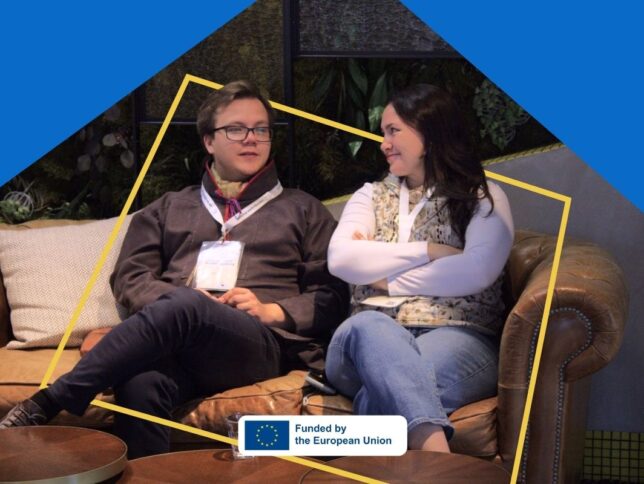
From the 27th of August until the 3rd of September, youth aged 18-35 from across the Arctic and Europe gathered in Brussels, Belgium for the Arctic Youth Dialogue (AYD) to discuss issues all around the topic of security and the Arctic. AYD is a four-day-event, complementing the two-day EU Arctic Forum, where participants create policy proposals in subgroups themed around four different topics and present them to policymakers at the EU Arctic Forum.
For the first time as a part of AYD, there was a Youth Media Team, which aimed to document the event from various angles and create projects that reflect the Arctic and our youth. Aiming to fulfill this purpose, I chose to put a focus on the indigenous languages of the Arctic. Over 40 different indigenous languages are spoken across the Arctic, and form a key part of culture, environment, and security in the North. Through interviews with four participants that speak or are learning their indigenous language(s), we will explore the various intersections of language and the Arctic. If you would like to watch the full interviews, check them out here! The full version of this article, with insights from each of the participants, is also attached here!
Language Shaping our Everyday Perception of the World
Taniesha, one of the two Head Facilitators of AYD and learner of Upper Tanana, stressed the need to learn the language before it’s too late, citing that “our Elders speak of a time where we will see a change in the world, where we need to go back to living off the land”, and that if youth are getting further and further away from the land, they will not have the tools they need to survive. She notes that there are “two different worlds” in a way, when connecting indigenous languages to broader society, where the tools for life and survival, in coordination with the land lie in the language. In this sense, language provides a key, opening the door into cultural and self-preservation, given that Taniesha says that “our culture is where our strength lies”. If culture is inherently tied to language, then fostering the ability to learn, speak, and flourish through one’s own indigenous language is key in ensuring indigenous culture can persevere. Language is something that was stripped away from indigenous people, with “generations where boarding schools, where there was a lot of violence, it was taken away from them”, context which Taniesha provides. The revitalisation of indigenous languages, through education programmes, targeted support, the ability to access services like healthcare in one’s own language, therefore creates a vital dimension to the various topics discussed at AYD.
Language & the AYD topics
The subgroups at AYD focused on four different topics: Cultural Security, Health Security, Biodiversity and Climate Security, and Food Security. Aggiu, a participant in AYD as a part of the Food Security subgroup, looks at the importance of access to traditional foods and, by that, traditional ways of life. “There is a language loss when our communities are not connecting with our foods” she states. Given that language and food are so interconnected, Aggiu emphasises that “language lives through our foods, because that’s our way of life, it’s helped us survive.” In a way, the description and preparation of food through the use of indigenous languages, connected to the needs of the Arctic environment, helps to foster the necessary care needed for food consumption and supports the sustainable and secure survival in and of the Arctic.
Youth and the Importance of Preserving Indigenous Languages
Beyond the topics that were discussed at AYD, a key aspect of the event is the youth advocacy dimension, given that young people often do not get a seat at the table when Arctic issues are discussed. Mats’ä̀säna Mą, a participant in AYD and at one point one of the youngest speakers of her language, emphasises the importance of being able to speak to elders as a young person, noting that it’s empowering for her “to be one of the people who is able to do that before they head into the spirit world and leave us”. For her “to know that elders were given this opportunity to see through the elders’ own eyes and their own lens that the language is being picked up again and it isn’t dying” supports her and pushes her to continue learning and speaking the language, especially as a young person.
Finally, Juhán Nikolaus, the other Head Facilitator of AYD also speaks about the connectedness that speaking North Sámi offers him. “It’s a way to ground myself, to remind myself of who I am, where I come from, who I know, and the people who know me”. As such, a vital element of language is connection, even if language just looks like a different way of communicating at first, there are so many layers of social, environmental, and political impact that indigenous languages can have, and can achieve. Most importantly though, as Juhán Nikolaus states, “it makes me feel like I’m not alone.”
Written by: Sophia Stedman
–
This publication is part of the EU-funded Youth Together for Arctic Futures project. The project is led by the WWF Global Arctic Programme, in cooperation with the Arctic Youth Network, European Youth Parliament, Saami Council, Arctic Mayors’ Forum, Tromsø Kommune, University of Tromsø, and the Association of Polar Early Career Scientists. This publication was funded by the European Union. Its contents are the sole responsibility of the European Youth Parliament and partners and do not necessarily reflect the views of the European Union.